
The state's rules for a pool seaward of the line
The Coastal Construction Control Line marks the part of the beach and dune system that takes the brunt of a major storm. Building seaward of it is allowed, but pools, decks and fill there need a permit from the Florida Department of Environmental Protection on top of your local permit. The state's general permit for a pool at a single-family home sets limits that shape the design from the start:
| Rule | What it means for your pool |
|---|---|
| Landward of the 30-year erosion projection | Decides how far toward the dune the pool can reach |
| Bottom no more than 2 feet below existing grade, or fully above it | Most oceanfront pools are partly or fully raised |
| Excavated sand stays on site, seaward of the line | The sand becomes fill under the deck and around the pool, so grading is designed in |
| Total fill capped at 700 cubic yards | Limits how much the yard can be built up |
| Fill under decks placed at a stable slope, not held by retaining walls | Changes how raised decks are edged and planted |
| Permit valid for two years, with no extension | Design, engineering and the build calendar are lined up before it is issued |
We confirm the criteria that apply to your parcel during design. Lots that cannot meet the general permit go through an individual permit, which takes longer.
The sequence that gets a coastal pool built
Survey and soils, the week you sign
A current signed and sealed survey that shows the control line, and a geotechnical report. These are the long poles, so they start first.
Lock the design
Every structural decision is made before the state sees the application. Changes after submission restart the review.
Engineering
A sealed structural design sized to the soils report, including pilings if the report calls for them, and drainage details for the pool.
State and local permits
The state reviews in rounds; each response restarts its clock. The town or county permit runs alongside, and work starts only when both are in hand.
Pre-construction meeting
The contractor, the owner or their representative and the state field inspector meet on site to go over the permit conditions before anyone digs.
Build and inspect
Construction traffic and materials stay off vegetated dunes, and lighting is checked against the sea turtle rules after installation.
On our 2026 Ponce Inlet project this took about eleven months from signed contract to state permit. Most of that was reports and review. Starting early is the single biggest thing an owner can do.
Designing the raised pool
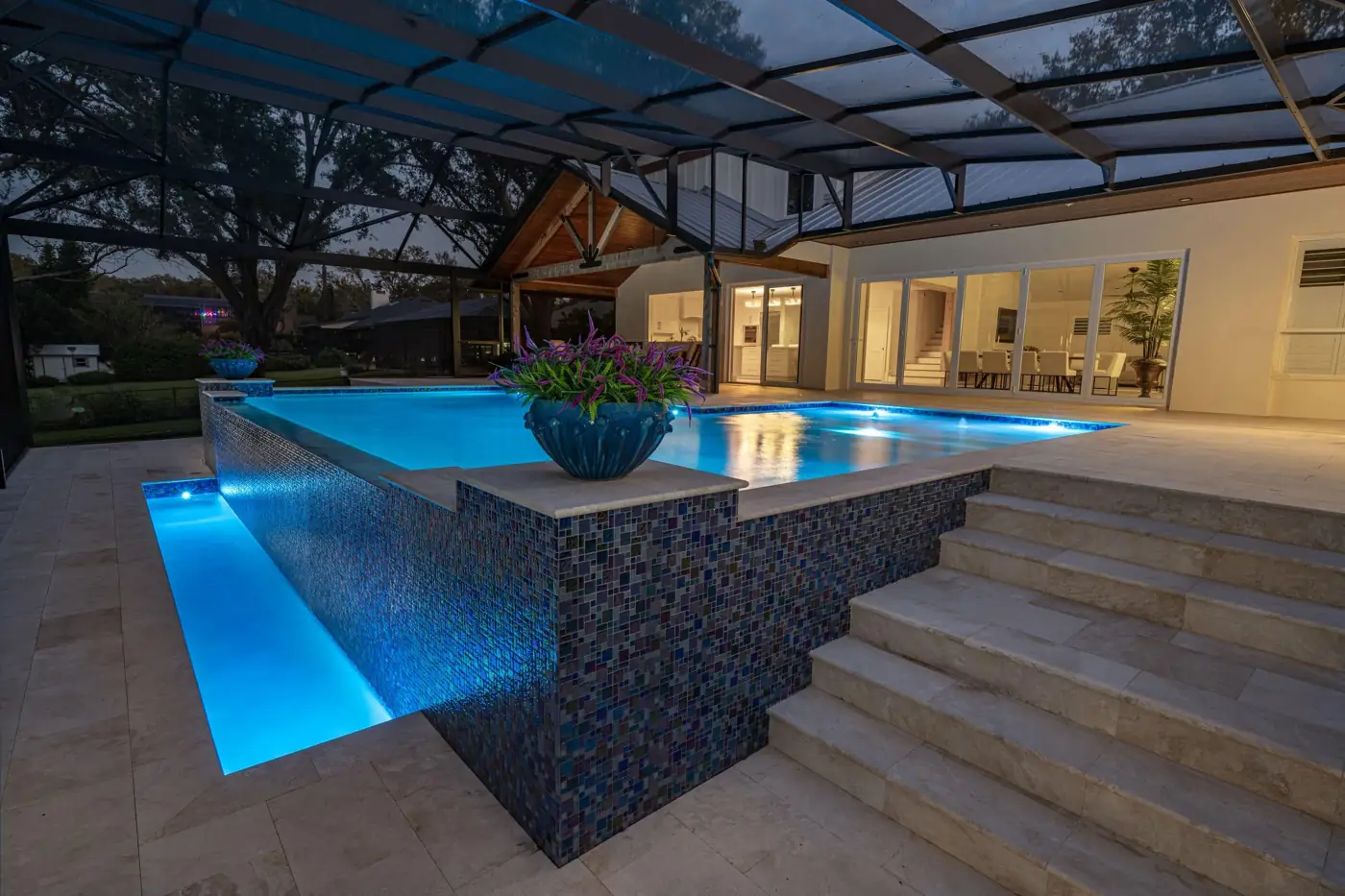
The grade limit is the reason oceanfront pools look the way they do. The good ones treat the height as an opportunity: the water line lines up with the floor of the house, the wall facing the ocean is clad in stone or glass, steps and built-in seating soften the side you walk up to, and the view from the living room goes straight over the water to the dunes. We wrote a whole guide on it: raised pools on oceanfront lots.
Lighting for nesting season
Volusia County's sea turtle lighting rules apply from May 1 to October 31, sunset to sunrise, and require beachfront lights to be shielded so they cannot be seen from the beach. On our Ponce Inlet project the pool lights sit in the ocean-side wall and shine back toward the house, and the guidance from the county's lighting specialist was lowest brightness and amber color during the season. We program the automation so the pool switches to its nesting-season settings on its own.
Built for salt, sand and wind
- Equipment. We install Jandy equipment exclusively, set the pad out of direct salt spray, and raise it where the flood zone requires.
- Hardware and finishes. Corrosion-resistant fixtures, coping and decking chosen for coastal exposure, and 316 stainless in outdoor kitchens.
- Groundwater. Beach sand and a high water table mean careful compaction, dewatering during excavation and hydrostatic relief in the shell.
- Wind. Screen enclosures near the coast are engineered for higher wind loads and designed with the pool, not added after.
- Flood zones. In V and Coastal A zones, a vanishing edge wall must be engineered and documented to meet flood requirements. We involve the engineer during design.
What it adds to the budget
Pilings, geotechnical work, structural engineering, the state permit and raised construction are line items an inland pool does not have. That is why most oceanfront pools land in our Signature ($175,000 to $325,000) or Monument ($325,000 and up) tiers. Our guide to what an oceanfront pool costs breaks it down.